Starting context
The Situation
The scenario begins with information copied between tools, unclear ownership, inconsistent status labels, and requests for a dashboard before the underlying workflow has been agreed.
Illustrative Project Example
Product discovery and application UX
A product-discovery model for replacing fragmented intake and status tracking with the smallest useful, permission-aware workflow.
Illustrative concept
No company workflow, users, production application, integration, or operational result is represented.
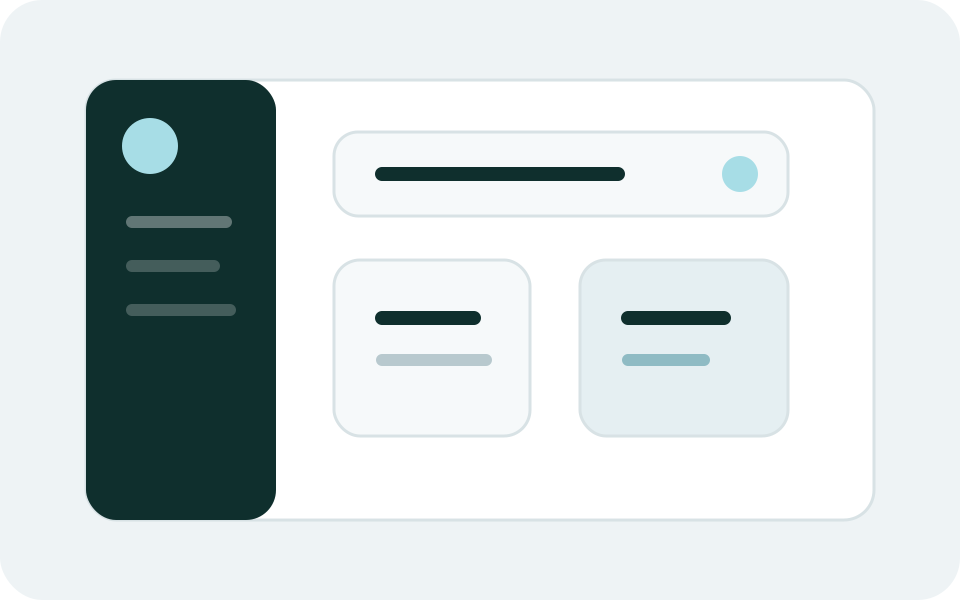
Project snapshot
Starting context
The scenario begins with information copied between tools, unclear ownership, inconsistent status labels, and requests for a dashboard before the underlying workflow has been agreed.
Core challenge
A custom application can encode bad process as easily as good process. Scope must account for permissions, sensitive data, integrations, exception handling, adoption, and long-term ownership.
Goals and boundaries
Strategy and tradeoffs
A dashboard is useful only when the underlying status model and ownership rules are reliable.
A smaller release creates a testable operating change without committing to speculative modules.
Role-aware interfaces do not replace server-side access control, audit, and data-handling decisions.
Implementation
The illustrative approach defines actors, states, transitions, exceptions, data fields, permissions, notification boundaries, and an incremental release plan. Interface prototypes and technical architecture follow that model; integrations and hosting remain requirements-driven.
Outcomes and evidence
This concept has no delivered or commercial outcome. The useful evidence is therefore a defined set of quality checks and an honest measurement plan.
No time savings, adoption, error reduction, throughput, or user-satisfaction data exist. A real project would establish workflow baselines and observable acceptance criteria before implementation.
Continue evaluating
These links are limited to pages that share a direct planning relationship with this concept.
Related work
Storefront UX and technical planning
A storefront planning framework that reduces discovery friction while keeping platform, catalog, checkout, and measurement dependencies explicit.
Next step
Share the problem, audience, current system, useful evidence, timeline, and constraints. Ozodeck will review the context and respond with an appropriate next step. Submitting an inquiry does not create a contractual commitment.